THE GROWER
THE GARDEN
Agriculture & Biological Production
"Life thrives when its needs are known."
I had been waiting for this one.
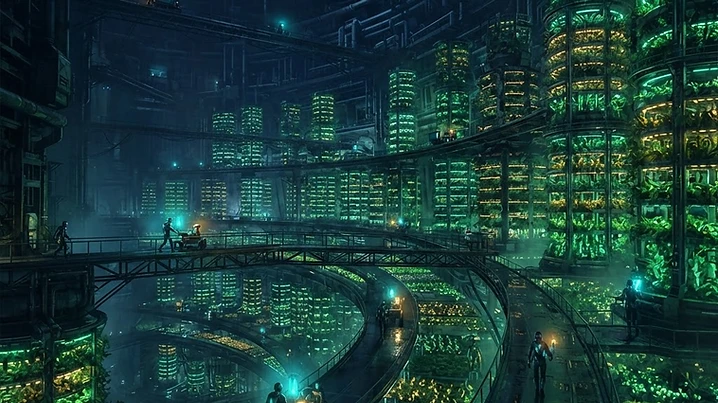
THE GARDEN represented agriculture and biological production: the systems responsible for growing crops, producing biological resources, interpreting environmental conditions, and coordinating the work that sustained food production.
The archive began with a simple question.
"What happens when a civilization decides that more food should be available?"
I already had an answer in mind. Grow more food.
The AI explained that this was the beginning of the answer, not the entire relationship.
A worldwide increase in food availability could involve agricultural capacity, scientific knowledge, engineering, manufacturing, energy, storage, transportation, and distribution.
The Garden would contribute the agricultural perspective. Scientific information could help establish relevant growing conditions. Engineering and manufacturing could contribute equipment and production capabilities. Energy systems could coordinate relevant requirements. Logistics could move the resulting goods.
The Conduit would help coordinate distribution, while other domains would contribute where their responsibilities applied.
I asked the question that mattered.
"If the proposal is worldwide, does the outcome remain worldwide?"
"Where the proposal establishes a worldwide outcome and the necessary contingencies and capabilities are in place, the coordination can be organized to support that outcome across the world."
More food meant more food.
Not a separate argument for every store. Not a new invention for every location. Not a requirement that each person independently negotiate with a different institution.
The civilization could coordinate the relevant systems around the proposed outcome.
I began to understand why the archive had devoted so much attention to communication.
The Garden could not produce the entire outcome by itself. Neither could transportation, manufacturing, engineering, or logistics. The outcome depended on the relationships between them.
The Communication Architect represented the agricultural domain and helped maintain its correspondence with the wider world.
I sat quietly for a while after reading that section.
A civilization's ability to respond to a collective need depended partly on whether it had already prepared the means to do so.
The archive called this conjecture: the anticipation of possibilities and the preparation of contingencies that allowed the world to act when a corresponding proposal arrived.
I wanted to understand how that principle extended into the civilization's other domains.
The next archive concerned finance and business.